Quite Red (Valspar 1011-3)
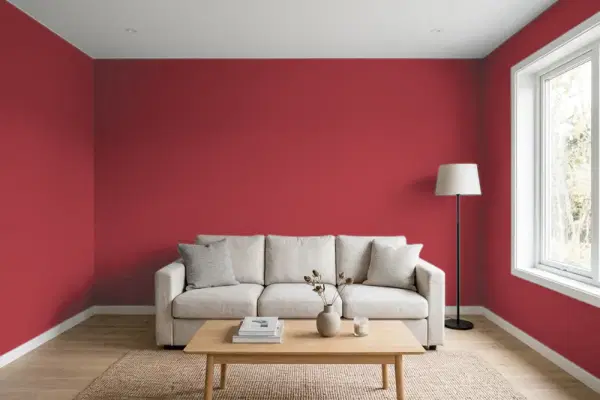
Illustrative room. Screen colors vary; test a sample before you paint.
Quite Red (Valspar 1011-3) is a very deep, warm red from Valspar: LRV 9, so it reflects about 9 percent of the light that hits it.
Colors that go with Quite Red
Three Valspar colors picked for Quite Red by this site's color math: a trim white, a quiet contrast from another family, a dark accent. Valspar did not choose these pairings.
Closest match in every other brand
Each brand's closest color to Quite Red, ranked by CIEDE2000 (deltaE): under 1.0 is indistinguishable, 1.0 to 2.3 very close, 2.3 to 5 noticeably different, over 5 clearly different.
| Brand | Closest color | Code | LRV | deltaE | How close |
|---|---|---|---|---|---|
| Sherwin-Williams | Red Bay | SW 6321 | 9 | 2.0 | very close |
| Benjamin Moore | Raspberry Truffle | 2080-10 | 10 | 1.4 | very close |
| Behr | Red Velvet | UL100-6 | 9.5 | 1.1 | very close |
| PPG Paints | Apple-a-day | 1051-7 | 10 | 2.8 | noticeably different |
Lighter and darker in Valspar
The Valspar red colors nearest to Quite Red (LRV 9) by LRV.
Lighter than Quite Red
Darker than Quite Red
Color data
| Brand | Valspar |
|---|---|
| Color code | 1011-3 |
| Hex | #94353C |
| RGB | 148, 53, 60 |
| HSL | 356°, 47%, 39% |
| LRV (light reflectance value) | 9 |
| Lab L*, a*, b* | 36.3, 40.5, 17.2 |
| Undertone | Warm Yellow-Red |
| Temperature | warm |
| Color family | Red |
Same paint, two kinds of light
Quite Red (Valspar 1011-3), published as #94353C
#862C3B
#A23E3B
These swatches and the rooms above are a simulation, not a measurement. How the visualizer works
Similar shades from Valspar
More from Valspar
Common questions
- What is the LRV of Quite Red (Valspar 1011-3)?
- Quite Red has an LRV of 9. LRV runs from 0 (black) to 100 (pure white) and measures the share of light a surface reflects, so Quite Red is a very deep color.
- What is the closest match to Quite Red in another brand?
- Red Velvet (Behr UL100-6) from Behr, at a deltaE of 1.1 (very close).
- Is Quite Red warm or cool?
- Valspar lists Quite Red as warm, with a Warm Yellow-Red undertone. Its Lab b* value is 17.2; a higher b* is warmer and yellower, a lower one cooler and bluer.
Sources: LRV and hex as published by the manufacturer, via PaintDB (CC BY 4.0). Color differences are CIEDE2000 values computed by this site from the hex values (data snapshot 2026-10-01). Color names and codes belong to their manufacturers.