Slumber Sloth (SW 9606)
Slumber Sloth (SW 9606) from Sherwin-Williams has an LRV of 56; its closest match in another brand is Smokey Taupe (BM 983) from Benjamin Moore (deltaE 0.3, indistinguishable).
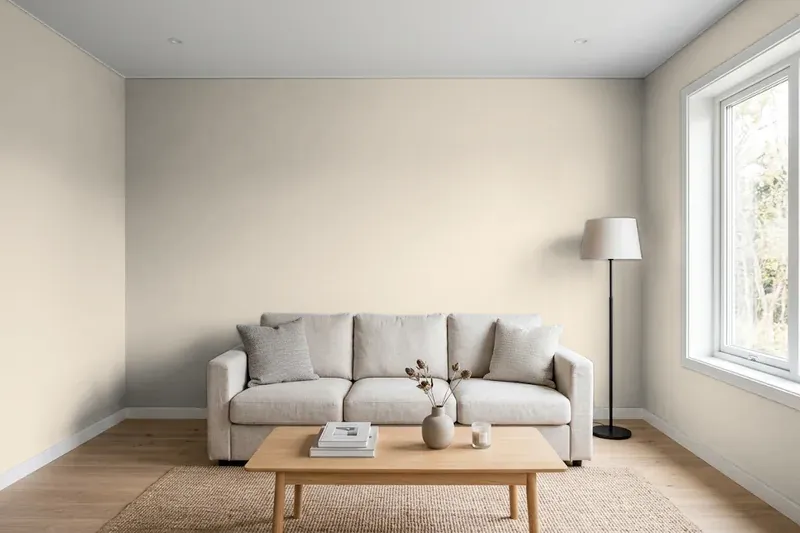
AI-made illustrative room; our code paints the walls. Screen colors vary; test a sample before you paint.
Slumber Sloth (SW 9606) is a medium color from Sherwin-Williams that PaintDB files under Beige: LRV, how much light the paint reflects, is 56, so it reflects about 56 percent of the light that hits it.
Colors that go with Slumber Sloth
Four Sherwin-Williams colors picked for Slumber Sloth by this site's color math: a trim white, a deeper beige, a contrast from another family, a dark accent. Sherwin-Williams did not choose these pairings.
Closest match in every other brand
Each brand's closest color to Slumber Sloth, ranked by deltaE, how different two colors look (the CIEDE2000 formula): under 1.0 is indistinguishable, 1.0 to under 2.3 very close, 2.3 to 5.0 noticeably different, over 5.0 clearly different.
| Brand | Closest color | Code | LRV | deltaE | How close |
|---|---|---|---|---|---|
| Benjamin Moore | Smokey Taupe | 983 | 54.5 | 0.3 | indistinguishable |
| Behr | Sculptor Clay | PPU5-08 | 55.2 | 0.5 | indistinguishable |
| Valspar | Oatbran | 6006-1B | 56 | 0.8 | indistinguishable |
| PPG Paints | Synchronicity | 1021-2 | 57 | 0.5 | indistinguishable |
Best rooms for Slumber Sloth
Slumber Sloth reads warm: its color strength (chroma) is 8.7, at or above this site's tinted line of 7.9.
| Room | Why |
|---|---|
| North-facing room | Keeps more brightness than 6 in 10 colors here in north light (L*, the lightness number, 75.9), and loses more color than 8 in 10 colors here (chroma drop 4.8). |
| South-facing room | Warmer than 5 in 10 colors here in south light (Lab b*, the yellow-to-blue number, 14.4). |
| Small or dim room | Lighter than 6 in 10 colors here (LRV 56). |
| Large sunny room | Lighter than 6 in 10 colors here (LRV 56). |
| Whole house | Less colorful than 7 in 10 colors here (chroma 8.7). |
Counts computed from the LRV and Lab values in this table; no room test was done.
Lighter and darker in Sherwin-Williams
The Sherwin-Williams beige colors nearest to Slumber Sloth (LRV 56) by LRV.
Lighter than Slumber Sloth
Darker than Slumber Sloth
Color data
| Brand | Sherwin-Williams |
|---|---|
| Color code | SW 9606 |
| Hex | #CEC5B6 |
| RGB | 206, 197, 182 |
| HSL | 38°, 20%, 76% |
| LRV (light reflectance value) | 56 |
| Lab L*, a*, b* | 79.9, 0.6, 8.6 |
| Undertone (PaintDB) | Warm |
| Temperature (PaintDB) | warm |
| Color family | Beige |
Same paint, two kinds of light
Slumber Sloth (SW 9606), published as #CEC5B6
#BDBBB4
#DFCFB6
These swatches and the rooms above are a simulation, not a measurement. How the visualizer works
Similar shades from Sherwin-Williams
Comparisons that include Slumber Sloth (SW 9606)
More from Sherwin-Williams
Common questions
- What is the LRV of Slumber Sloth (SW 9606)?
- Slumber Sloth has an LRV of 56. LRV runs from 0 (black) to 100 (pure white) and measures the share of light a surface reflects, so Slumber Sloth is a medium color.
- What is the closest match to Slumber Sloth in another brand?
- Smokey Taupe (BM 983) from Benjamin Moore, at a deltaE of 0.3 (indistinguishable).
- Is Slumber Sloth warm or cool?
- Slumber Sloth reads warm: its chroma is 8.7, at or above this site's tinted line of 7.9. Its Lab b* value is 8.6; a higher b* is warmer and yellower, a lower one cooler and bluer.
- What colors go with Slumber Sloth?
- Slumber Sloth goes with Panda White (SW 6147) as a trim white, Studio Clay (SW 9172) as a deeper beige, Frosted Fern (SW 9648) as a contrast from another family, Nocturne (SW 9520) as a dark accent. This site's color math picked them from Sherwin-Williams's colors; Sherwin-Williams did not choose these pairings.
- Is Slumber Sloth good for a north-facing room?
- In north light, Slumber Sloth keeps more brightness than 6 in 10 colors here (L* 75.9) and loses more color than 8 in 10 (chroma drop 4.8).
Sources: LRV and hex as published by the manufacturer, via PaintDB (CC BY 4.0). Color differences are CIEDE2000 values computed by this site from the hex values (data snapshot 2026-10-01). Color names and codes belong to their manufacturers.