Tudor Brown (BM HC-185)
Tudor Brown (BM HC-185) from Benjamin Moore has an LRV of 6.4; its closest match in another brand is Turkish Coffee (SW 6076) from Sherwin-Williams (deltaE 0.7, indistinguishable).
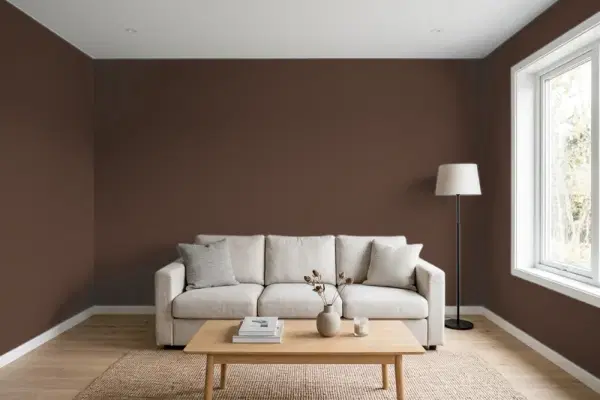
AI-made illustrative room; our code paints the walls. Screen colors vary; test a sample before you paint.
Tudor Brown (BM HC-185) is a very deep color from Benjamin Moore that PaintDB files under Brown: LRV, how much light the paint reflects, is 6.4, so it reflects about 6 percent of the light that hits it.
Colors that go with Tudor Brown
Four Benjamin Moore colors picked for Tudor Brown by this site's color math: a trim white, a deeper brown, a contrast from another family, a dark accent. Benjamin Moore did not choose these pairings.
Closest match in every other brand
Each brand's closest color to Tudor Brown, ranked by deltaE, how different two colors look (the CIEDE2000 formula): under 1.0 is indistinguishable, 1.0 to under 2.3 very close, 2.3 to 5.0 noticeably different, over 5.0 clearly different.
| Brand | Closest color | Code | LRV | deltaE | How close |
|---|---|---|---|---|---|
| Sherwin-Williams | Turkish Coffee | SW 6076 | 5 | 0.7 | indistinguishable |
| Behr | Cordovan Leather | BXC-78 | 6.5 | 3.7 | noticeably different |
| Valspar | Roasted Coffee | 2009-10 | 9 | 7.2 | clearly different |
| PPG Paints | Racy Raisin | 16-24 | 7 | 5.2 | clearly different |
Best rooms for Tudor Brown
Tudor Brown reads warm: its color strength (chroma) is 12.5, at or above this site's tinted line of 7.9.
| Room | Why |
|---|---|
| North-facing room | Keeps less brightness than 9 in 10 colors here in north light (L*, the lightness number, 22.5), and loses more color than 6 in 10 colors here (chroma drop 4.3). |
| South-facing room | Warmer than 5 in 10 colors here in south light (Lab b*, the yellow-to-blue number, 16.0). |
| Small or dim room | Darker than 9 in 10 colors here (LRV 6.4). |
| Large sunny room | Darker than 9 in 10 colors here (LRV 6.4). |
| Whole house | Less colorful than 5 in 10 colors here (chroma 12.5). |
Counts computed from the LRV and Lab values in this table; no room test was done.
Other paints named Tudor Brown
Lighter and darker in Benjamin Moore
The Benjamin Moore brown colors nearest to Tudor Brown (LRV 6.4) by LRV.
Lighter than Tudor Brown
Darker than Tudor Brown
Color data
| Brand | Benjamin Moore |
|---|---|
| Color code | HC-185 |
| Hex | #4F3A30 |
| RGB | 79, 58, 48 |
| HSL | 19°, 24%, 25% |
| LRV (light reflectance value) | 6.4 |
| Lab L*, a*, b* | 26.5, 7.7, 9.8 |
| Undertone (PaintDB) | Warm |
| Temperature (PaintDB) | warm |
| Color family | Brown |
Same paint, two kinds of light
Tudor Brown (BM HC-185), published as #4F3A30
#42322F
#5C422F
These swatches and the rooms above are a simulation, not a measurement. How the visualizer works
Similar shades from Benjamin Moore
More from Benjamin Moore
Common questions
- What is the LRV of Tudor Brown (BM HC-185)?
- Tudor Brown has an LRV of 6.4. LRV runs from 0 (black) to 100 (pure white) and measures the share of light a surface reflects, so Tudor Brown is a very deep color.
- What is the closest match to Tudor Brown in another brand?
- Turkish Coffee (SW 6076) from Sherwin-Williams, at a deltaE of 0.7 (indistinguishable).
- Is Tudor Brown warm or cool?
- Tudor Brown reads warm: its chroma is 12.5, at or above this site's tinted line of 7.9. Its Lab b* value is 9.8; a higher b* is warmer and yellower, a lower one cooler and bluer.
- What colors go with Tudor Brown?
- Tudor Brown goes with Frosty Pink (BM 2010-70) as a trim white, Tudor Brown (BM PM-24) as a deeper brown, Under the Sea (BM 693) as a contrast from another family, Tarpley Brown (BM CW-170) as a dark accent. This site's color math picked them from Benjamin Moore's colors; Benjamin Moore did not choose these pairings.
- Is Tudor Brown good for a north-facing room?
- In north light, Tudor Brown keeps less brightness than 9 in 10 colors here (L* 22.5) and loses more color than 6 in 10 (chroma drop 4.3).
Sources: LRV and hex as published by the manufacturer, via PaintDB (CC BY 4.0). Color differences are CIEDE2000 values computed by this site from the hex values (data snapshot 2026-10-01). Color names and codes belong to their manufacturers.